
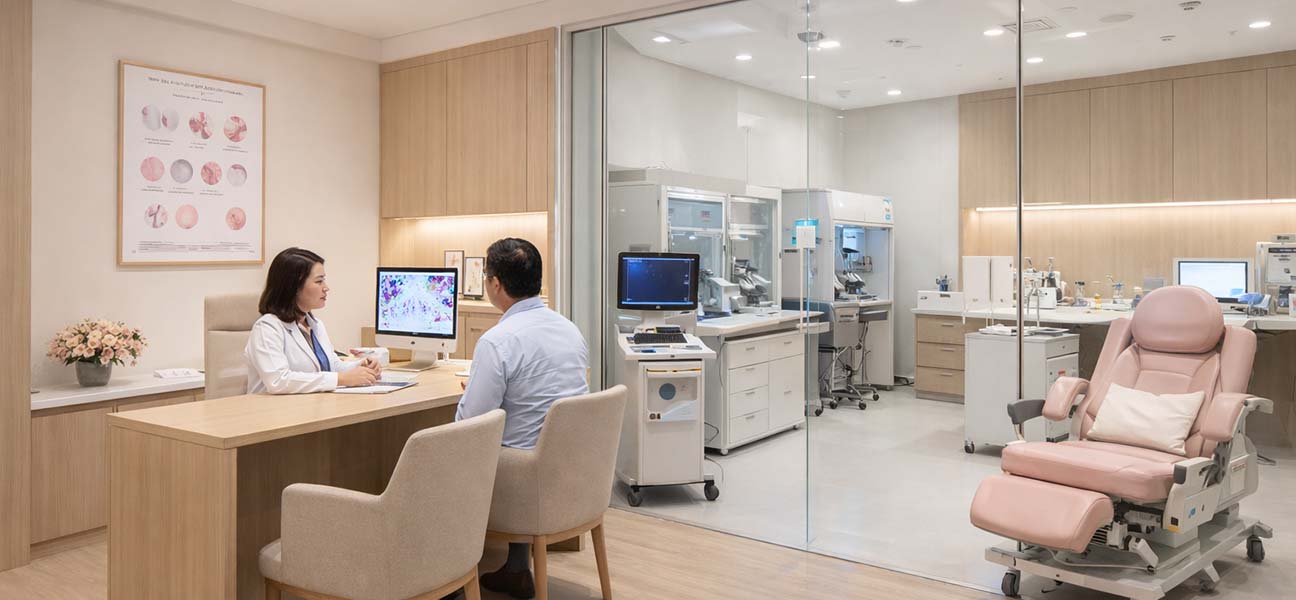
Real Consultation Scenario: A 38-Year-Old Client with Diminished Ovarian Reserve Asks
"I've had two failed IVF attempts in my home country, and my AMH is only 0.8. My doctor suggested considering Georgia. There's an agency there offering a full-cycle concierge service, covering everything from visa and accommodation to hospital coordination, for a package price of over one hundred thousand RMB. I want to know if this service is really worth it? Or is it just a way to charge more money?"
This question comes up almost every week. Georgia, as a popular assisted reproduction destination in recent years, has seen its "full-cycle concierge service" concept heavily promoted, but the actual content varies greatly. The following analysis breaks it down from three levels: the real process, medical logic, and common pitfalls.
Direct Answer: What is the Full-Cycle Concierge Service for IVF in Georgia?
The full-cycle concierge service is essentially a combination product of cross-border medical coordination + life support. It typically includes:
- Medical Assistance: Hospital appointments, translation accompaniment, report delivery, doctor communication
- Living Arrangements: Airport pickup, accommodation, local transportation, dietary advice, daily companionship
- Legal/Document Support: Assistance with visa applications, document notarization, marriage certificate translation, birth certificate processing (if involving third-party assisted reproduction)
- Psychological Support: Some agencies provide basic psychological counseling or group communication
But note: Most concierge services do not include medical decision-making power — the doctor is the ultimate decision-maker for the treatment plan. The concierge is mainly responsible for execution and communication and cannot replace the doctor's judgment.
Doctor's Perspective: The Limited Impact of Concierge Services on Medical Outcomes
From a reproductive medicine perspective, the three core factors affecting IVF success rates, in order of importance, are: egg/sperm quality, embryo chromosomal normality, and uterine environment. Concierge services have almost no direct ability to intervene in these three areas. A reproductive doctor practicing in Tbilisi for 8 years once stated clearly: "I would rather patients spend time adjusting their thyroid function and supplementing with Vitamin D than worrying about whether the hotel has Chinese food." However, the doctor also acknowledged that the stress caused by language barriers and chaotic processes can indeed elevate cortisol levels, indirectly affecting endocrine function and implantation. Therefore, the greatest value of a concierge service lies in reducing patients' non-medical anxiety, especially for those traveling abroad for the first time.
Easily Overlooked Detail: The Concierge's "Medical Knowledge Boundary"
A significant number of patients mistakenly believe the concierge "understands medicine" and ask them, "What stimulation protocol should I use?" or "Should I accumulate eggs with such low AMH?" This is high-risk behavior. Concierges usually only have basic medical training (if any) and cannot interpret key indicators like hormone levels (FSH, LH, E2), endometrial thickness on ultrasound, or embryo grading. If a concierge gives non-professional advice, it could lead to wrong decisions. The correct approach: All medical questions must be asked directly to the doctor through a translator, and the translator should be provided by the hospital or hold medical translation qualifications, not be the concierge acting in a dual role.
Common Pitfalls: Vague Service Terms and Opaque Fee Breakdown
Common traps in Georgia's full-cycle IVF concierge services include:
| Pitfall | Specific Manifestation | How to Avoid |
|---|---|---|
| "Full-cycle" does not include repeat cycles after medical failure | If one egg retrieval fails, you need to pay the concierge fee again for the next cycle | Clearly specify in the contract whether it covers the "first cycle" or "the entire treatment cycle until the end of transfer" |
| Accommodation is far from the hospital | Claims "free accommodation," but it's actually a 1-hour drive from the hospital | Request the hospital name and use a map app to verify the commute time in advance |
| Low translation quality, unfamiliar with medical terms | Translating "follicle count" as "number of eggs," causing doctor misunderstanding | Request the translator's medical certification or relevant work experience |
| Hidden fees | Embryo freezing fees, PGT rush fees, legal fees not included in the package price | Request a complete fee breakdown and confirm each item |
Actual Process: Standard Steps of a Full-Cycle Concierge for IVF in Georgia
- Initial Consultation and Evaluation: Collect medical reports from both partners (AMH, semen analysis, hormone panel, chromosomes, etc.). The doctor makes a preliminary assessment of feasibility. The concierge is responsible for organizing and translating reports and scheduling remote video consultations.
- Document Preparation: Passports (validity must cover the entire cycle, recommended over 6 months), notarized and apostilled marriage certificate (if legal procedures are involved), visa (Georgia offers e-visas for Chinese citizens, usually 5-10 days). Required documents: original and translated copies of both partners' ID cards, household registration books, marriage certificates, and specified medical reports.
- Departure and Arrival: The concierge arranges airport pickup and takes you to the pre-arranged accommodation (apartment or hotel). It is advisable to confirm details like kitchen facilities, laundry, and natural light in advance, as a good resting environment is needed during ovarian stimulation.
- Registration and First Consultation: Both partners go to the hospital to create a medical file and sign informed consent forms. Georgian hospitals usually require recent (within 3 months) infectious disease screening (HIV, syphilis, hepatitis B, hepatitis C). If not done, it can be done locally, but this may delay the process by 1-2 days.
- Cycle Initiation: Based on the doctor's protocol (long protocol, short protocol, antagonist protocol, etc.), ovarian stimulation begins. The concierge is responsible for reminding about medication times, accompanying for ultrasound monitoring, and picking up medications.
- Egg/Sperm Retrieval: Egg retrieval is usually performed under general anesthesia, with a 2-4 hour observation period post-procedure. The concierge needs to check for complications (bloating, bleeding), but emergencies must be handled by contacting the hospital emergency room.
- Embryo Culture and Screening: The lab performs ICSI fertilization, blastocyst culture, and PGT-A/PGT-M (if needed). This stage takes 5-7 days. The concierge is responsible for delivering embryo reports, but interpretation of genetic reports must be done by a genetic counselor or the doctor themselves.
- Embryo Transfer: Transfer in a natural cycle or hormone replacement cycle. Post-transfer luteal phase support medications (dydrogesterone, progesterone injections, etc.) must be used as prescribed. The concierge can assist with purchasing and administering injections, but dose adjustments are at the doctor's discretion.
- Pregnancy Test and Follow-up: Blood test for hCG 12-14 days after transfer. If pregnancy is confirmed, the concierge assists in arranging a post-return pregnancy maintenance plan and handling the renewal of fees for remaining frozen embryos.
Timeline: How Long Does One IVF Trip to Georgia Take?
- First trip to Georgia (stimulation + egg retrieval + blastocyst culture): Minimum stay of 18–25 days (depending on the stimulation protocol)
- If frozen embryo transfer is needed: Second trip to Georgia stays 12–16 days (endometrial preparation + transfer + pregnancy test)
- If fresh transfer is used: One stay is sufficient, lasting 22–30 days
- Involving third-party assisted reproduction (e.g., egg donation, surrogacy): The process is more complex, usually requiring multiple trips to Georgia or remote collaboration, with a total span of about 3-6 months
Note: IVF hospitals in Georgia usually do not require both partners to be present for the entire duration. The male partner generally only needs to be at the hospital on the day of sperm retrieval (can stay for 2-3 days).
Suitable Candidates
- First-time IVF travelers abroad with no language skills: In this case, a concierge can significantly reduce the initial confusion.
- Advanced maternal age with low ovarian reserve (AMH < 1.0): Frequent adjustments to the stimulation protocol are needed. Having someone to help record, remind about appointments, and follow up can reduce errors.
- Those needing PGT (genetic screening): Involves multi-step communication, especially after embryo biopsy results are out, requiring liaison with a genetic counselor. Having a professional translator is more reliable.
- Individuals with mild anxiety or depression: Facing treatment alone in a foreign country can worsen emotional issues. The companionship and basic psychological support from a concierge can be valuable.
Unsuitable Candidates
- Very tight budget: Concierge services usually add 30,000-80,000 RMB. If you are fluent in English, have done your research, and are independent, you can coordinate directly with the hospital (some Georgian hospitals have Chinese-speaking customer service).
- High demand for medical privacy: The concierge will have access to almost all personal medical information. If you have privacy concerns, choose an agency with a confidentiality agreement or avoid small-scale individual concierges.
- Experienced with overseas medical treatment and knowledgeable about medical basics: These individuals can handle visas, translation, and hospital communication themselves, making the extra cost for a concierge service low value for money.
- Those promised unrealistic success rates: Any claim that "concierge service guarantees success" is fraudulent. The overall live birth rate for IVF in Georgia varies by age: approximately 55-65% for women under 35, dropping to 20-35% for those over 40.
Frequently Asked Questions (Observations from Practitioners)
Q: Does the full-cycle concierge service include third-party assisted reproduction?
A: Usually not. Georgian law permits commercial surrogacy (for foreign couples), but most concierge services sign separate contracts: one for medical + life coordination, and another for the legal surrogacy agreement. Be sure to confirm them separately.
Q: My AMH is only 0.6. Can the concierge help with egg accumulation?
A: They can coordinate multiple egg retrievals (accumulation cycles), but the medical protocol is determined by the doctor. The concierge is responsible for recording the results of each cycle and scheduling follow-up appointments. A reminder: the total cost of multiple retrievals increases significantly. Confirm in advance whether the concierge service fee is charged per cycle.
Q: Which full-cycle concierge service in Georgia is reliable?
A: We cannot recommend specific agencies. Criteria for evaluation: ① Can they provide a written agreement for direct cooperation with the hospital? ② Do they have a fixed office location and full-time employees? ③ Can they provide genuine feedback from past patients (not fabricated reviews)? ④ Does the contract specify refund rules for中途 withdrawal?
Risk Reminders
The regulatory system for IVF in Georgia differs from that in China, and channels for handling medical disputes are limited. When choosing a concierge service, be sure to pay attention to the following:
- Medical Responsibility Allocation: If a cycle fails or physical injury occurs due to hospital error, will the concierge assist in rights protection? The contract usually states that "the concierge is not responsible for medical liability," but at a minimum, they should have an obligation to assist with translation and legal aid coordination.
- Financial Security: Avoid paying the entire fee to the concierge at once. It is recommended to pay in stages: 30% after visa, 40% after arrival, 30% after transfer completion. There have been cases of unscrupulous agencies absconding with funds.
- Backup Plan: No matter how thorough the concierge service is, the patient must maintain the right to be informed about their own test results (e.g., AMH, FSH, endometrial thickness) and proactively ask the doctor, "Why is this protocol chosen?" Do not rely entirely on the concierge to relay information.
- Reserve for Extra Expenses: If Ovarian Hyperstimulation Syndrome (OHSS) occurs during stimulation, hospitalization may be required for a few days. This cost is usually not included in the concierge package. It is advisable to prepare an additional 10,000-20,000 RMB as emergency medical funds.
Finally, the full-cycle concierge service for IVF in Georgia is a product that adds convenience but does not solve core medical problems. Its value lies in making the process smoother, but it cannot change hard medical factors like egg quality or embryonic chromosomal abnormalities. Before making a decision, complete a fertility assessment through formal channels first. Then, go to the doctor with clear data to determine whether the concierge fee is truly useful for you.
Comments (0)