
Consultation Scenario: The Complete Path from Address to Appointment
A 42-year-old woman, after a remote consultation, decided to go to the GI Rimon Fertility Center in Tbilisi, Georgia, for egg freezing. Her first questions were: "Where exactly is the center? Is it convenient from the airport? How long do I need to stay nearby?" Behind these questions lies not just a geographical location, but the entire overseas medical journey planning, time costs, and medical process coordination. Starting from the address, the following breaks down the key information before and after the appointment.
Direct Answer: GI Rimon Fertility Center Address
GI Rimon Fertility Center in Georgia is located in the Vake District of the capital city, Tbilisi. The specific address is:
- Address in Georgian: 27a Nutsubidze Street, Tbilisi, Georgia
- Address in English: 27a Nutsubidze Street, Vake, Tbilisi, Georgia
- Postal Code: 0177
This address is in a well-established medical and diplomatic area in western Tbilisi, surrounded by numerous private hospitals, pharmacies, and embassies. The center independently occupies a three-story building with a dedicated entrance and parking spaces. First-time visitors are advised to use navigation software and enter "GI Rimon Fertility Center" or "27a Nutsubidze Street" for direct directions.
Transportation Options from Tbilisi International Airport to the Center
| Transportation Method | Estimated Time | Cost Reference (GEL) |
|---|---|---|
| Taxi (Bolt/Yandex) | 35-45 minutes | 40-60 |
| Hotel Airport Transfer | 35-45 minutes | 80-120 |
| Public Transport (Bus + Metro) | 70-90 minutes | 2-3 |
For patients carrying medical documents or needing rest, it is recommended to use a ride-hailing service or a hotel transfer directly to the center's entrance. The public transport option is suitable for companions who are already familiar with the local area and have a less tight schedule.
Actual Process: Patient Flow Upon Arrival at the Center
From arriving at the center to completing the first consultation, the following steps are typically involved:
- Front Desk Registration: Provide your passport, medical appointment confirmation, and previous examination reports (it is recommended to bring English or Russian translations).
- Record Creation and Document Verification: The nurse checks the validity of your documents (passport must be valid for at least 6 more months) and visa type (medical or tourist visa are both acceptable, but ensure the stay covers the treatment cycle).
- Initial Doctor Consultation: The reproductive specialist takes a medical history, performs a basic fertility assessment (AMH, FSH, LH, antral follicle count), and evaluates suitability. For older patients (≥40 years old), the doctor focuses on follicle quantity and quality and discusses whether PGT-A screening is needed.
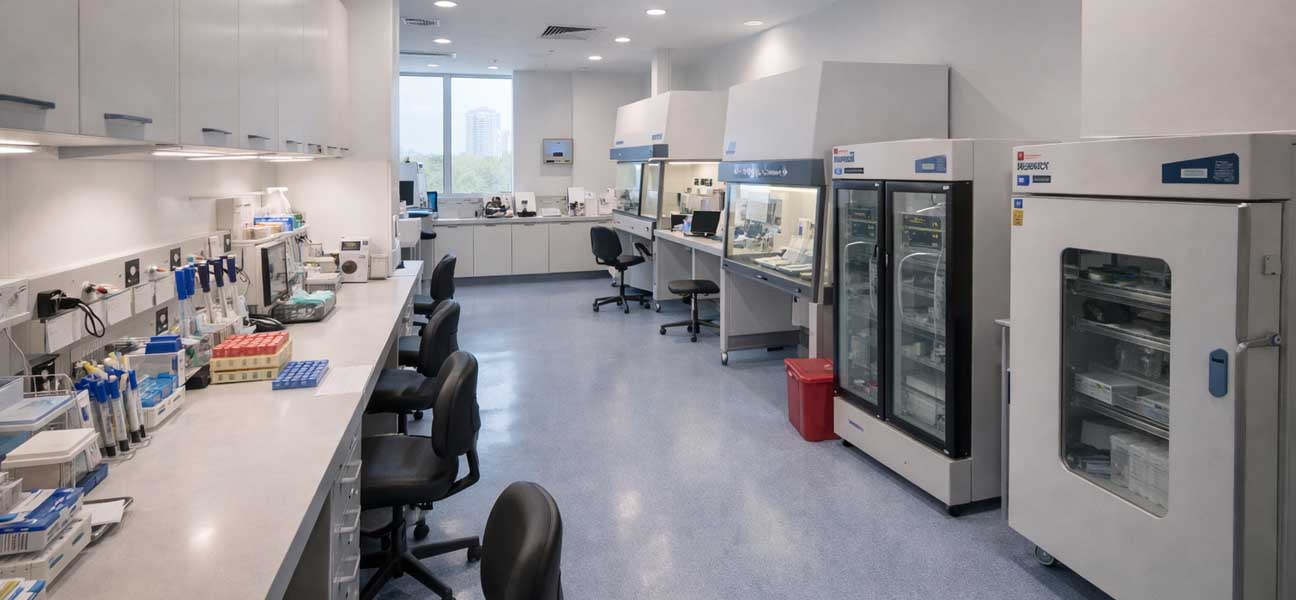
- Laboratory Tour: Subject to biosafety regulations, some patients can schedule a visit to the embryology lab to learn about the culture environment and equipment configuration.
- Treatment Plan Formulation: Based on the examination results, an ovarian stimulation protocol (long, short, or antagonist protocol) is developed, and a medication prescription is provided.
- Pharmacy Collection: The center has an in-house pharmacy. Most stimulation medications can be collected on-site, while a few special medications need to be ordered 1-2 days in advance.
The entire process takes approximately 2-3 hours. If additional tests are required (such as hysteroscopy, semen analysis, or genetic counseling), it may need to be completed over two days.
Easily Overlooked Details: Hidden Costs Related to the Address
After confirming the address, most people only focus on "how to get there," but overlook the following three details:
- Matching Accommodation with Treatment Cycle: The area around the center is a mid-to-high-end residential district. Monthly rent for a serviced apartment is approximately $800-$1,500 USD. If the treatment cycle exceeds 3 weeks (e.g., fresh embryo transfer + luteal phase support), it is advisable to choose an apartment with a kitchen for dietary management and medication refrigeration.
- Cold Chain Transport for Medications: Some stimulation medications need to be stored at 2-8°C. If the travel time from the center's pharmacy to your accommodation exceeds 15 minutes, a portable cooler bag should be used. The center can usually provide disposable ice packs, but in limited quantities.
- Language Support Window: The center has English and Russian coordinators, but Chinese support is only available during specific hours (usually 10:00 AM to 4:00 PM). If visiting outside these hours, it is recommended to arrange for an interpreter in advance or use an online translation device.
Common Pitfalls: Address and Navigation Errors
Based on observations from practitioners over the past two years, patients often make the following three mistakes when using navigation:
- Inaccurate Name Input: Some map applications autocorrect "GI Rimon" to "JI Rimon" or "GI Rimond," leading to navigation to a different commercial building 2.3 km away. It is recommended to enter "27a Nutsubidze Street" as a backup location.
- Ignoring One-Way Street Restrictions: Nutsubidze Street has one-way traffic controls during the morning peak (8:00-9:30) and evening peak (17:00-18:30). Self-driving patients need to take a detour via Rustaveli Street. Taxi drivers are usually familiar with this rule, but those renting a car should plan ahead.
- Confusing Main Entrance with Side Entrance: The main entrance of the center faces Nutsubidze Street, but navigation sometimes directs vehicles to the service passage at the back of the building. This passage is for staff only, and patients need to walk around to the front door. For the first visit, it is advisable to take a taxi or private transfer to avoid unnecessary delays.
Time Planning: Appointment Timeline Centered Around the Address
Using egg freezing or IVF as an example, the timeline from the first visit to the center to completing egg retrieval is as follows:
| Stage | Time Required | Key Actions |
|---|---|---|
| Preliminary Remote Consultation & Test Preparation | 2-4 weeks | Complete AMH, FSH, semen analysis, infectious disease screening, and chromosome testing. Some tests need to be done locally and are usually valid for 6-12 months. |
| First On-site Registration & Evaluation | 1 day (approx. 2-3 hours) | Bring passport, visa, and previous medical reports. Ensure passport validity ≥ 6 months. |
| Ovarian Stimulation Cycle | 10-14 days | Visit the center daily or every other day for follicle monitoring (blood test + ultrasound). The center's address is fixed; it is recommended that accommodation be within a 20-minute drive. |
| Egg Retrieval Surgery | 1 day (surgery approx. 30 min, observation 2 hours) | Surgery takes place in the operating room on the second floor. Fasting for 8 hours is required beforehand. |
| Embryo Culture & PGT (if applicable) | 5-7 days (biopsy + freezing) | During this stage, patients can travel within Georgia but must keep their phone on to receive embryo reports. |
| Transfer Cycle (Frozen Embryo) | 1 day | Usually occurs during the 2nd or 3rd menstrual cycle after retrieval. Endometrial preparation must start at the center 5 days prior. |
For patients only undergoing egg freezing, the timeline can be shortened to 10-14 days (excluding any subsequent transfer).
Frequently Asked Questions: Address-Related Decisions
1. Who is a suitable candidate for GI Rimon Fertility Center?
Suitable for the following individuals:
- Patients who need PGT (third-generation IVF) technology and wish to avoid strict domestic regulations.
- Individuals with reasonable ovarian reserve (AMH ≥ 1.0 ng/mL, antral follicle count ≥ 6) but seeking higher laboratory standards.
- Patients with specific requirements for embryology lab hardware, such as incubators and time-lapse imaging systems.
2. Who might not be suitable for this center?
- Patients with very low AMH (< 0.4 ng/mL) and a history of poor response to other stimulation protocols. It is recommended to first evaluate the suitability of using an egg donation program.
- Patients requiring 24/7 Chinese-language support, as the center currently only offers Chinese support during specific hours.
- Individuals with extremely limited budgets who cannot afford the accommodation costs in the surrounding area.
3. Why does the address choice affect treatment success rates?
The address directly impacts the frequency of visits and medication management. During ovarian stimulation, frequent monitoring at the center is required (average 4-6 visits). If the accommodation is more than a 30-minute drive from the center, it not only increases physical strain but could also lead to missing the optimal egg retrieval time due to traffic delays. Additionally, the local climate (hot and dry in summer, cold and humid in winter) can affect some patients' physical condition, requiring prior adaptation.
4. How should I prepare documents for overseas IVF?
The following materials are needed:
- Passport: Valid for at least 6 months; it is advisable to prepare 2 photocopies.
- Visa: Georgia offers e-visas or visa-free entry for some nationalities, but for medical purposes, applying for a medical visa (requiring an invitation letter from the center) is recommended. The stay is usually 30-90 days.
- Marriage Certificate: For married patients, a notarized translation of the marriage certificate (English or Russian) is required.
- Previous Medical Reports: All examination reports must be translated into English and stamped by the local hospital.
Practitioner's Observation: Matching Medical Resources Behind the Address
As an overseas coordinator with 10 years of experience, I have noticed a phenomenon: when many people search for "GI Rimon address," they are actually evaluating, "Can I get there smoothly and complete my treatment?" The convenience of the address determines the patient's psychological security and indirectly affects treatment compliance. Before booking flights and accommodation, it is recommended to confirm the following three points with the center's coordinator via a remote video call:
- Does the center offer a free first-time airport pickup service (included in some packages)?
- Are there apartments nearby that meet medical standards (24-hour hot water, elevator, medication refrigeration conditions)?
- What is the location of the nearest general hospital (for handling emergencies such as Ovarian Hyperstimulation Syndrome - OHSS)?
If these conditions are met, then the address is no longer just a coordinate, but a stable link in the treatment chain.
Time Planning Reminder: Checklist from Address Confirmation to Departure
Before you finalize the GI Rimon Fertility Center address and plan your trip, please prepare according to the following milestones:
- 4 weeks before departure: Complete AMH, FSH, semen analysis, infectious disease screening, and chromosome testing. Older patients (≥38 years old) are advised to additionally undergo genetic counseling and hysteroscopy evaluation.
- 2 weeks before departure: Confirm passport validity > 6 months, apply for a medical visa (if needed), and book accommodation within a 15-minute walk from the center.
- 1 week before departure: Translate all medical reports into English, scan them for backup, and prepare both electronic and paper copies.
- 1 day before departure: Simulate the route from your accommodation to the center using a navigation app, and note alternative transportation methods.
The above arrangements can minimize treatment delays caused by unfamiliarity with the address or time constraints.
Comments (0)