
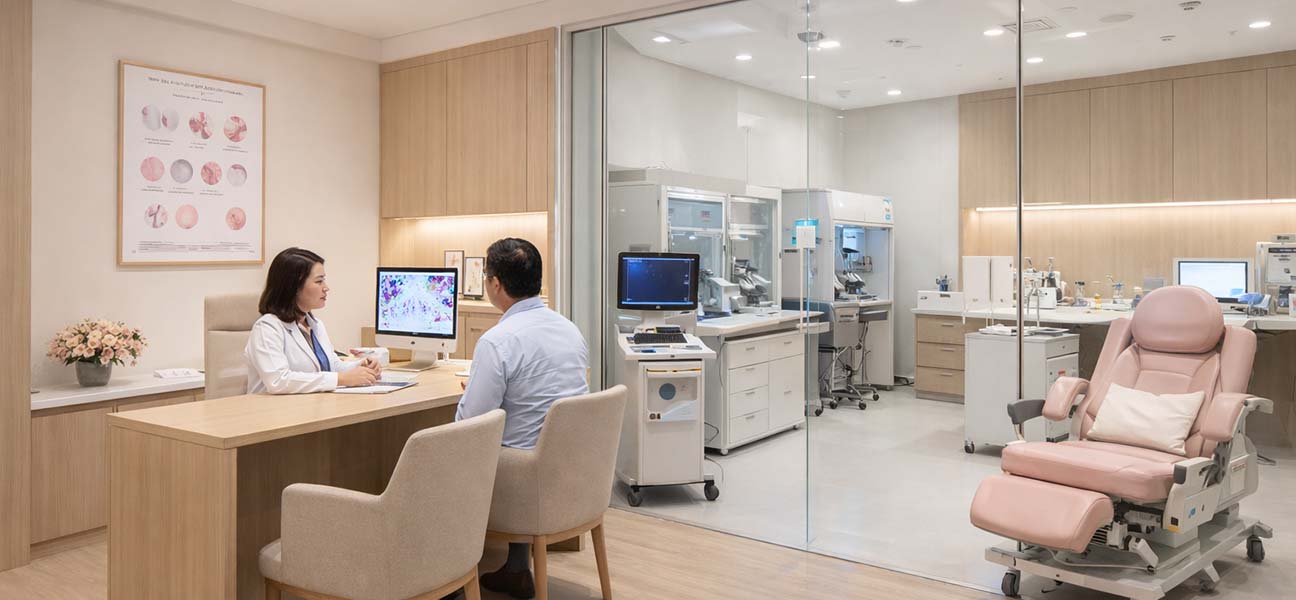
Opening: Real Consultation Scenario
"Coordinator, I am 36 years old with an AMH of only 1.2. I want to go abroad for PGT. I have looked into both Thailand and Georgia, but I don't know which is the safer choice. What are the legal risks? Is there a big difference in medical standards? What is the total cost difference?" — This was a client's exact question during a consultation last week, and it is the same question almost everyone torn between these two destinations asks.
Core Difference Between the Two Locations: A One-Sentence Summary
Thailand and Georgia each have advantages and disadvantages in assisted reproduction. The core differences center on legal restrictions on embryo genetic testing, concentration of medical resources, total cost range, and patient identity requirements.
- Legal Aspects: Thailand allows PGT-A/PGT-M (PGT) on embryos but prohibits surrogacy (only legally married couples with a medical necessity can apply for legal surrogacy, under extremely strict conditions); Georgia explicitly permits third-party assisted reproduction (surrogacy) and is more friendly towards single parents/same-sex families. PGT is also legal, but PGT-M (for monogenic diseases) requires individual approval by an ethics committee.
- Medical Standards: Top Thai fertility centers (e.g., Jetanin, BNH, Samitivej) have embryo lab hardware and doctor experience on par with international standards, handling a high volume of advanced age and complex cases; Georgia relies on experienced reproductive doctors (e.g., Beta Hospital, Innova, Chachava) with internationally certified labs, but overall case volume and diversity are slightly lower than Thailand.
- Costs: A single PGT cycle in Thailand totals approximately 100,000-150,000 RMB (excluding flights and accommodation); in Georgia, it is about 80,000-120,000 RMB (including basic translation and coordination services). If surrogacy is needed, the total cost in Georgia (including surrogate compensation, legal fees, medical fees) is approximately 350,000-550,000 RMB, while surrogacy is not applicable in Thailand.
- Visa and Stay Duration: Thailand offers a 15-day visa on arrival, a medical visa allows up to 60 days stay, and the process for stimulation + transfer takes about 25-30 days; Georgia offers a 30-day e-visa for Chinese citizens (single stay up to 30 days), and the process typically takes 20-25 days.
Reproductive Doctor's Perspective: Factors Influencing Choice Between Locations
Based on discussions with several reproductive doctors in Thailand and Georgia, I have compiled their core considerations when making decisions:
Thai doctors focus more on: Patient's ovarian reserve (AMH, AFC), reasons for previous failures (embryo chromosomal abnormalities, endometrial factors), and the need for PGT-M. For advanced age (≥38) patients with repeated implantation failure or miscarriage, Thai doctors tend to use PGT-A to screen for euploid embryos; for patients with a family history of monogenic genetic diseases, Thailand's PGT-M technology is mature with a relatively fast approval process.
Georgian doctors focus more on: Whether the patient needs third-party assistance (surrogacy), preference for embryo sex (Georgian law allows sex selection, Thailand prohibits non-medical sex selection), and budget limits. If the patient is a single male or same-sex couple, Georgia is one of the few destinations where it is explicitly legal and the process is smooth.
A reproductive consultant with 12 years of experience in Tbilisi told me: "Many clients think Georgia is just cheap, but actually our PGT screening price is about 30% cheaper than Thailand, and in the last two years we have introduced German embryo time-lapse monitoring systems, steadily improving live birth rates." However, this does not mean Georgia is suitable for everyone—for families needing PGT-M and wanting a fast track, Thailand still has a more mature genetic counseling team.
Detailed Differences Between the Two Countries: From Process to Details
The following table can help quickly compare core differences:
| Comparison Dimension | Thailand | Georgia |
|---|---|---|
| Legality of PGT | Legal, PGT-A/PGT-M both allowed. Requires ID cards and marriage certificate for both spouses. | Legal, PGT-A unrestricted, PGT-M requires individual approval (approx. 2-4 weeks). |
| Legality of Surrogacy | Only for married couples with medical necessity (extremely difficult to obtain approval). | Explicitly legal by law; foreigners have the same rights as Georgian citizens. |
| Required Documents | Passport, marriage certificate (with dual apostille), visa, notarized marriage certificate. | Passport, marriage certificate (translated and notarized only), visa, and birth certificate (additional declaration if single). |
| Single Cycle Cost (excluding surrogacy) | 100,000-150,000 RMB (including medication, tests, PGT-A for 8 embryos). | 80,000-120,000 RMB (including basic services, PGT-A extra approx. 15,000-20,000). |
| Average Stay Duration | 25-30 days (stimulation 12-14 days, rest 3-5 days after transfer). | 20-25 days (stimulation 12-14 days, observation 2-3 days after transfer). |
| Medical Language Support | Most hospitals have dedicated Chinese translators. | Mainly relies on agencies or hospital-coordinated translators; Chinese language services are limited. |
| Success Rate Reference (under 35) | Single cycle live birth rate approx. 55-65%. | Single cycle live birth rate approx. 50-60%. |
| Embryo Sex Selection | Prohibited (except for sex-linked genetic diseases). | Allowed. |
Easiest Details to Overlook: Policy Timeliness and Medical Continuity
Based on our coordination center's data over the past three years, over 40% of clients overlook two key issues during initial decision-making:
- Risk of Policy Changes in Thailand: After Thailand's comprehensive ban on commercial surrogacy in 2015, the scope of PGT application has been adjusted multiple times. In 2023, the Thai Ministry of Health proposed tightening PGT-A application, which is still under discussion. Choosing Thailand requires monitoring policy trends to avoid中途 obstacles.
- Embryo Freezing and Transportation in Georgia: Georgian hospitals usually do not offer multi-cycle embryo freezing packages. Patients needing multiple transfers after egg retrieval must pay additional freezing fees (approx. 3,000-5,000 RMB/year). Furthermore, if patients wish to transport embryos to another country in the future, logistics costs and compliance procedures in Georgia are more complex than in Thailand.
Another easily overlooked detail is transportation costs: Bangkok has many direct flights and moderate living costs; Tbilisi has fewer direct flights (often requiring connections), and long-term accommodation options are limited. These hidden costs (flights, accommodation, food) can accumulate to a difference of 10,000-20,000 RMB.
Easiest Pitfalls: Agency Transparency and Medical Agreements
In my work as an overseas coordinator, I have seen too many disputes caused by information asymmetry:
- Pitfalls in Thailand: Some agencies advertise "guaranteed success packages," but bundle multiple transfer costs without including PGS screening fees, leading to actual expenses exceeding the budget. Additionally, some small clinics in Thailand use imported stimulation medications not certified by the Thai FDA (TFDA), affecting follicle development.
- Pitfalls in Georgia: Surrogacy contracts can be lax—some do not clearly specify the installment payment schedule for surrogate compensation; some patients fail to confirm the surrogate's health screening report (e.g., infectious diseases, psychological evaluation) in advance, leading to cycle cancellations. Furthermore, some Georgian hospitals have insufficient backup power for embryo labs, with cases of power outages affecting embryo thawing.
Actual Process: What Needs to Be Done at Each Destination
IVF Process in Thailand (Example: PGT)
- Pre-departure checks in home country: AMH, sex hormone panel, antral follicle count via ultrasound, semen analysis, full infectious disease panel, chromosome karyotype. Results in about 2 weeks.
- Legal document preparation: Dual apostille of marriage certificate (Chinese/English), passport scan, visa application (medical visa or STV). Takes 3-4 weeks.
- Departure for Thailand (Day 1-2 of menstruation): Ovarian stimulation (average 12-14 days), with 3-4 blood tests and ultrasounds for monitoring.
- Egg retrieval surgery: Under general anesthesia, about 30-40 minutes. Rest 1-2 days after retrieval before returning home.
- Embryo culture + PGT (in Thailand): Blastocyst culture for 5-6 days, biopsy and testing, PGT-A results in about 10-14 days. PGT-M requires an additional 2-4 weeks.
- Second trip to Thailand for transfer: Arrive on cycle day 10-12, prepare endometrium (5-7 days), rest 3-5 days after transfer before returning home.
IVF Process in Georgia (Including Surrogacy)
- Pre-departure checks in home country: Similar to Thailand, but may require an additional psychological evaluation report as required by surrogacy laws (some agencies).
- Apply for e-visa: 30-day stay, usually approved within 3-5 working days.
- Travel to Georgia for stimulation + egg retrieval: Process similar to Thailand, but hospital schedules are more紧凑, stimulation usually 10-12 days. Embryo culture after retrieval.
- Surrogate matching: Requires 2-3 months in advance to screen surrogates (height, blood type, previous birth history, infectious disease and genetic disease screening). If using a self-found surrogate, a notarized agreement between both parties is needed.
- Embryo transfer: The surrogate undergoes endometrial preparation at the appropriate time in her menstrual cycle, pregnancy test 12-14 days after transfer.
- Legal procedures: After the surrogate child is born, birth certificate, parentage determination, and passport must be obtained (usually takes 2-4 weeks).
Factors Influencing Costs: Which Hidden Expenses Easily Exceed the Budget
The cost difference between the two locations is not just medical fees; it also includes several easily underestimated variables:
| Variable | Thailand | Georgia |
|---|---|---|
| Agency Service Fee | Usually included in the package, approx. 20,000-40,000 RMB. | Not included in some hospitals; separate translation/coordination fee approx. 10,000-20,000 RMB. |
| Medication Costs | Imported drugs like Gonal-f, Puregon, average 12,000-18,000 RMB. | Uses similar European imported drugs, price similar or slightly lower by 10%. |
| Embryo Freezing Fee | First year free, subsequent years approx. 2,000-4,000 RMB/year. | Charged annually, approx. 3,000-5,000 RMB/year. |
| Additional Screening (PGT-M) | Additional 3,000-5,000 RMB per embryo. | Requires individual approval, total cost 15,000-25,000 RMB (including legal fees). |
| Living Costs (25 days) | Accommodation + food approx. 12,000-20,000 RMB (mid-range hotel). | Accommodation + food approx. 8,000-15,000 RMB. |
If choosing surrogacy in Georgia, the largest variable in total cost is the surrogate compensation (approx. 120,000-180,000 RMB) and legal/psychological support fees (approx. 30,000-50,000 RMB). Costs for prenatal check-ups, hospitalization, and unexpected cesarean sections during the surrogate's pregnancy are borne by the patient, adding an estimated 20,000-40,000 RMB.
Frequently Asked Questions: Questions We Answer Every Day
Q1: Which has a higher success rate, Thailand or Georgia?
It cannot be simply compared because patient demographics differ. Thailand receives more advanced age and complex cases, so overall live birth rates may appear lower statistically; Georgian patients are relatively younger, and many go there for surrogacy needs. For a one-to-one comparison, it is best to match age, AMH, and etiology, then look at the hospital's historical data. Generally, public data shows: Top Thai centers have a single-cycle live birth rate of 55-65% for those under 35, while Georgia has 50-60%.
Q2: Should I choose Thailand or Georgia if my AMH is low (0.5-1.0)?
If AMH is below 1.0 and age is ≥38, Thailand may have more experience with stimulation protocols (e.g., mild stimulation, PPOS protocols) and it is easier to find centers specializing in low ovarian reserve. Georgia has less exposure to such cases, but there are doctors skilled in low stimulation (requires specific verification).
Q3: Can a single male do it?
Thailand does not allow single males to undergo IVF (even using a surrogate). Georgian law allows single males to obtain parental rights through surrogacy, but they must provide proof of medical necessity (e.g., inability to father a child). In practice, many single males have successfully completed the process legally in Georgia.
Q4: What documents are needed? Any validity requirements?
Passport validity must exceed the planned return date by at least 6 months. Thailand requires a dual apostille on the marriage certificate (usually valid for one year); Georgia only requires translation and notarization (no validity limit, but it is recommended to obtain it within 3 months before departure). For visas, a Thai medical visa requires booking about 1 month in advance, while a Georgian e-visa takes 3-5 days.
Comments (0)